
The Adaptation Curve
An operator's view from the curve.

I was homeschooled until 8th grade. One pattern from that time stuck: I learned to learn differently. It served me well during the early days of remote work in the pandemic. And it has been wildly beneficial to learning new techniques, new tools, and new paradigms in this AI wave.
But learning and growth aren’t linear, and they aren’t comfortable. Any time someone tries to change something meaningful, they run the same six stages. Eight years ago I was chatting with friends and drew this curve on a whiteboard.
I called it the Adaptation Curve.
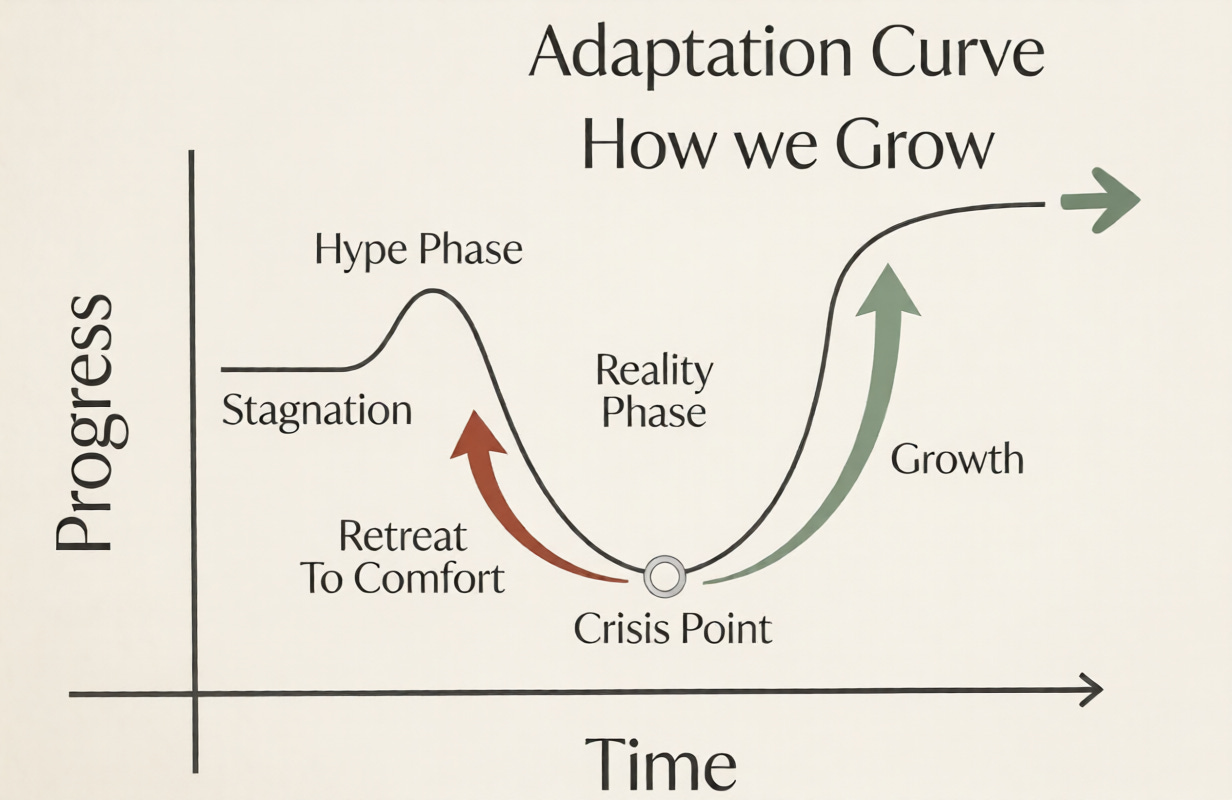
The stages went like this. Stagnation, where trying to maintain the norm is actually a slow decline. If you’re maintaining, someone else is pushing forward. The Hype Phase, where the excitement of change carries you for a short period. The Reality Phase, where the excitement wears off and the work gets harder than expected. You’re building things no one is seeing. It’s tedious. Then you hit the Crisis Point, the low point inside the Reality Phase, where you question every choice that got you there. And with it comes a decision. Retreat to Comfort, where you turn back to what you knew — safe, but stagnant. Or Growth, where you push through and the small results start to compound to a new level.
What struck me then, and strikes me harder now, is what happens when you zoom out. A single curve looks painful. It’s a U, or a bowl. But life isn’t one curve. A career isn’t one curve. It’s stacked curves. And if you draw a trendline through the staircase of someone who keeps pushing through Crisis Points, it’s a positive trajectory up-and-to-the-right. The people and companies that look like they’re continuously improving over a decade are secretly navigating dozens of these curves underneath. The ones that plateau aren’t the ones who never hit a Crisis Point. They’re the ones who hit one, retreated, and never started another curve.
I flushed out the framework for a few years. Then I went and ran more curves of my own. I ran growth and analytics for an early-stage e-commerce brand and grew it from $3M to $22M ARR, taught myself to code over about eighteen months, ran product at a growth agency with a front-row seat to over 100 companies going through their curves, and built ORCA and Cortex. I hadn’t thought about the Adaptation Curve in a while. It was a framework from a prior chapter.
Then I started noticing the same shape in everyone around me.
I’ve been on my own curve for a year. The Hype Phase when AI-native felt obvious and the first demos landed. The Reality Phase when the gap between demo-grade and production-grade kept showing up. The Crisis Point (more than one, honestly) where I had to decide whether to keep pushing on a thesis I couldn’t yet prove. I pushed. I’m on the Growth side now, and it feels like another curve is coming.
Almost everyone I talk to is somewhere on this curve, and most of them are anxious. The Hype Phase is over. The demos were amazing, the pilots launched, a few things shipped. Now we’re in the Reality Phase, and the Reality Phase sounds like “I know this has wild potential but I don’t know how it’s going to affect me.” It sounds like friends and former colleagues telling me they can’t quit their jobs because they can’t afford to not spend the next three to six months playing with AI. It sounds like Elena Verna publishing a piece about her own imposter syndrome. It sounds like a small handful of companies growing at unprecedented rates while the productivity gains haven’t shown up for anyone else, and every LinkedIn and X talking head is promising the next unlock if you’ll just comment for the prompt. The noise is everywhere, the anxiety is real, and almost nobody is admitting it out loud.
I’m one of the few people I know who is genuinely excited. Not because I think AI is going to fix everything; it isn’t. And not because I’ve figured it out; I haven’t. I’m excited because I’ve drawn this curve enough times to know what the anxiety actually is. It’s the Crisis Point, and the Crisis Point is a fork. Retreat to the old stack and wait for the hype to pass. Or push forward, roll up your sleeves, and commit to building something new. The companies and people who push forward are going to pull away. Not because they’re smarter. Because they didn’t retreat. They kept operating. And that effort compounds.
A note on who this is for. Every adaptation curve ends at the same fork, and the fork is a choice. That’s the part of the framework that matters most. At the Crisis Point, the work stops being about strategy and starts being about self-determination. I’m an optimist for people with gumption — the ones who take initiative to learn, stay curious, put themselves in situations they don’t fully know how to navigate yet. Those people are going to compound in this era. Everyone else is going to feel squeezed and wonder why. The curve doesn’t care. The choice is always yours.
Welcome to the Adaptation Curve.